An e-bike is not a toy. It’s a vehicle capable of 25 km/h that weighs 30–40 kg and shares space with pedestrians, cars, and other cyclists. Before handing your teenager the charger and waving them out the door, consider having them read and sign a clear set of expectations — not as punishment, but as preparation.
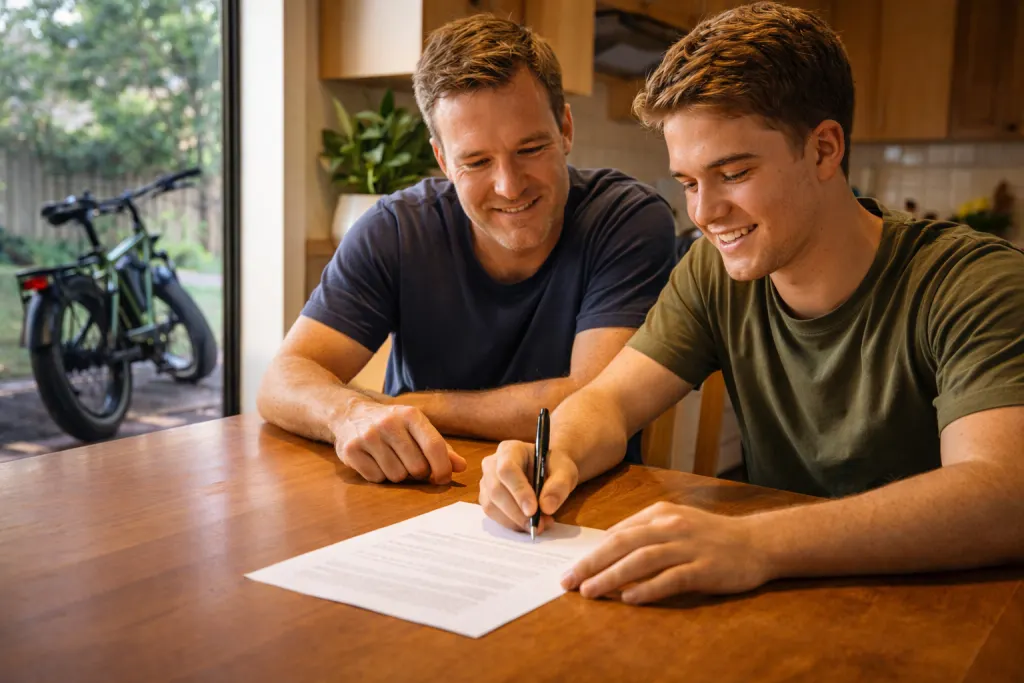
Ready to go? Grab the contract.
A printable PDF you can discuss, adapt, and sign together.
Download the E-Bike Contract (PDF)A parent-teen e-bike contract might sound formal. It is. That’s the point. Riding an e-bike on public roads comes with real legal obligations, real physical risk, and real financial consequences if something goes wrong. A written agreement makes those realities concrete before the first ride, not after the first incident.
Why a Contract Matters
Most families manage e-bike rules informally. “Be careful.” “Wear your helmet.” “Don’t do anything stupid.” These are fine sentiments, but they’re vague — and vague rules lead to vague consequences.
A written contract does several things that a verbal reminder cannot.
It sets expectations before something goes wrong. When the rules are written down and signed, there’s no room for “I didn’t know” or “you never said that.” Both parent and teenager have a shared, documented understanding of what responsible riding looks like.
It makes the teenager an active participant. A contract isn’t something done to your teenager — it’s something done with them. Reading, discussing, and signing the agreement puts them in the role of a responsible road user, not just a kid being told what to do.
It creates clear, pre-agreed consequences. If a rule gets broken, you’re not making up a punishment on the spot (which feels arbitrary) or letting it slide (which erodes the rules). The consequences were agreed to before the breach happened. That’s fairer for everyone.
It normalises riding privileges coming with obligations. This is exactly how a provisional driver’s licence works — you earn the privilege by demonstrating responsibility. An e-bike contract is the same principle, scaled for a younger rider.
What the Contract Should Cover
Every family is different, but a solid e-bike agreement covers these areas. Adapt the specifics to your teenager’s age, experience, and the type of riding they’ll be doing.
Helmet — Every Ride, No Exceptions
This is non-negotiable and it’s the law in every Australian state and territory. A properly fitted, AS/NZS 2063-certified helmet must be worn on every ride. Not hanging from the handlebars. Not sitting on the back of the head. Buckled, snug, and level.
If your teenager rides to school and “forgets” the helmet for the ride home, that’s a breach. Make this the clearest, simplest rule in the contract.
No Modifications
No modifications to the motor, controller, speed limiter, or electrical system. Full stop. Derestricting an e-bike — removing the 25 km/h speed limit — is one of the fastest ways to turn a legal bicycle into an illegal motor vehicle. It also voids the warranty, can damage the motor and battery, and dramatically increases the risk of a serious crash.
Teenagers are curious and online forums make derestricting look easy. The contract should make clear that any tampering with the bike’s electronics is treated as a serious breach.
No Passengers
Unless the bike is specifically rated and equipped for carrying a passenger — with a proper seat, footpegs, and load rating — no carrying passengers. An e-bike designed for one rider handles differently with a second person on the back: braking distances increase, steering becomes unpredictable, and the risk of a fall multiplies.
Obey Road Rules and Path Speed Limits
E-bike riders have the same legal obligations as any other cyclist. That means stopping at red lights, giving way where required, using hand signals, and riding in the correct direction. On shared paths, most jurisdictions set a speed limit of 10–15 km/h near pedestrians.
This is worth spelling out because many teenagers (and adults, frankly) treat shared paths as open roads. The contract should be specific: obey posted speed limits, give way to pedestrians, and slow down near schools, playgrounds, and bus stops.
No Riding Under the Influence
This might seem premature for a 14-year-old, but it won’t always be. No riding under the influence of alcohol, drugs, or any substance that impairs judgement or reaction time. In most Australian states, drink-driving laws apply to cyclists — including e-bike riders. A teenager riding an e-bike while intoxicated can be fined and, in some states, have the offence recorded.
Set the expectation early and clearly.
Phone Stays in Pocket
No texting, no scrolling, no calling while riding. Music through a single earbud is a grey area — some families allow it, others don’t — but earbuds in both ears is a bad idea and illegal in several states. The contract should require the phone to stay in a pocket or bag while the bike is moving.
If your teenager needs navigation, a handlebar-mounted phone holder is a safer alternative — but the rule should be no touching the phone while riding.
Report Damage, Issues, and Near-Misses
Teenagers have a natural instinct to hide problems. A scratched rim seems minor; a near-miss with a car feels embarrassing. But unreported damage can become a safety issue, and near-misses are valuable learning opportunities.
The contract should require prompt reporting of any damage, mechanical issues, or close calls. Make clear that honest reporting will not be punished — the breach is in hiding it, not in the incident itself.
Lock the Bike Properly
E-bikes are expensive and attractive to thieves. The bike must be locked with a quality D-lock or heavy-duty chain lock whenever it’s left unattended — including at school. If the bike comes with a battery lock, the battery should be locked or removed when parked in a public area.
Keep the Bike Road-Legal
The bike must remain road-legal and compliant at all times. That means working lights (front white, rear red) for any riding in low light, working brakes on both wheels, a working bell, and reflectors. If something breaks, the teenager is responsible for reporting it — and the bike doesn’t get ridden until it’s fixed.
The Consequences Clause
Rules without consequences are suggestions. The contract should spell out exactly what happens when the agreement is broken, using a graduated response that matches the severity of the breach.
First breach (minor): A serious conversation. Review the relevant rule together. Document the breach. This is a warning, not a free pass — it goes on record.
Repeated breaches: The bike gets locked up for a defined period — one week for a second offence, two weeks for a third. The teenager doesn’t get to ride during this time. No exceptions, no negotiation.
Serious breach: Riding under the influence, dangerous riding, illegal modifications, or removing the speed limiter. The bike is sold. This isn’t a threat for leverage — it’s a genuine, pre-agreed consequence for behaviour that puts the rider or others at serious risk.
Financial responsibility: If reckless or illegal riding results in fines, property damage, or injury claims, the teenager contributes to paying those costs. This might mean using savings, getting a part-time job, or having the amount deducted from pocket money over time. The point is accountability — actions have financial consequences in the real world.
The Insurance Angle
Here’s something most families don’t think about until it’s too late: e-bikes have no compulsory third-party insurance in Australia.
When you register a car, CTP insurance is built into the registration fee. It covers injuries you cause to other people. E-bikes don’t require registration, which means there’s no CTP cover. If your teenager crashes into a pedestrian, rides into a parked car, or causes someone to swerve and fall, your family could face significant personal liability — potentially tens or hundreds of thousands of dollars.
Some home and contents insurance policies include personal liability cover that may extend to cycling incidents, but many don’t — and even those that do may exclude e-bikes or non-compliant bikes specifically. Check your policy. Consider standalone cycling insurance if your existing cover doesn’t extend to e-bike riding.
A contract that requires legal, responsible riding isn’t just about good behaviour — it’s a risk management tool. A teenager who follows the rules is dramatically less likely to cause the kind of incident that leads to a liability claim. For more on this gap, see our guide on e-bike crashes and safety data.
Making It Work
A contract that’s shoved across the kitchen table with a “sign this or no bike” will be resented, not respected. The process matters as much as the document.
Sit down and discuss each point together. Go through the contract line by line. Explain why each rule exists — not just “because I said so,” but the specific risk each rule addresses. A teenager who understands that derestricting voids insurance and can result in a $2,000+ fine is more likely to resist peer pressure to do it than one who was simply told “don’t.”
Let the teenager ask questions. They might disagree with a rule or want to negotiate. That’s healthy. Some rules are non-negotiable (helmet, no modifications, no riding drunk), but others might be worth adjusting. Maybe they want to use a single earbud for podcasts. Maybe they want a later curfew in summer when it stays light. A negotiated agreement has more buy-in than a dictated one.
Review it together after three months. Has the teenager been riding responsibly? Have any issues come up that the contract didn’t cover? Maybe it’s time to relax some restrictions — a longer permitted riding radius, for instance, or riding to a friend’s house they’ve demonstrated they can reach safely. The contract should evolve as the teenager demonstrates responsibility.
The goal is a shared understanding, not a gotcha. You’re not trying to catch your teenager breaking rules. You’re trying to build the habits and judgement that will keep them safe — on this bike, on their next bike, and eventually behind the wheel of a car.
Sample Contract Template
Below is a plain-English template you can adapt. It’s not a legal document — it’s a family agreement. Print it, modify it, and sign it together.
Download the contract as a printable PDF
E-Bike Riding Agreement
Rider: ____________________________
Parent/Guardian: ____________________________
Date: ____________________________
Bike Description: ____________________________ (brand, model, colour, serial number)
The Rules
By signing this agreement, I (the rider) agree to the following every time I ride the e-bike:
- Helmet: I will wear a properly fitted, certified helmet on every ride. No exceptions.
- Road rules: I will obey all road rules, traffic signals, and speed limits — including shared path speed limits.
- No modifications: I will not modify the motor, controller, speed limiter, or any part of the electrical system.
- No passengers: I will not carry passengers unless the bike is rated and equipped for it.
- No impaired riding: I will not ride under the influence of alcohol, drugs, or any impairing substance.
- Phone away: I will keep my phone in my pocket or bag while riding. No texting, calling, or scrolling on the move.
- Bike security: I will lock the bike properly with the provided lock whenever it is left unattended.
- Maintenance and reporting: I will report any damage, mechanical issues, or near-misses to my parent/guardian promptly. I will not ride a bike with broken lights, brakes, or other safety equipment.
- Compliance: I will keep the bike road-legal and compliant with Australian e-bike laws at all times.
- Riding area: I will ride only within the agreed area: ____________________________ (specify suburbs, routes, or boundaries).
The Consequences
We (rider and parent/guardian) agree to the following consequences if the rules above are broken:
- First minor breach: A conversation and formal warning. The breach will be recorded.
- Second minor breach: The bike is locked away for one week.
- Third minor breach: The bike is locked away for two weeks.
- Serious breach (impaired riding, illegal modifications, dangerous behaviour): The bike is permanently removed and sold.
- Financial responsibility: If my riding results in fines, property damage, or injury claims, I will contribute to paying those costs from my savings or earnings.
Review Date
We will review this agreement together on: ____________________________ (three months from signing date).
Signatures
Rider: ____________________________ Date: ____________
Parent/Guardian: ____________________________ Date: ____________
Frequently Asked Questions
What age should we start using a contract?
As soon as your teenager is riding an e-bike independently on public roads or paths. For most families, that’s between 12 and 15 years old. The contract can be simpler for younger teens — fewer rules, a smaller riding area — and expanded as they demonstrate responsible riding. See our teens and young riders guide for age-appropriate advice.
Is this contract legally enforceable?
No. It’s a family agreement, not a legal document. Its value is in the conversation it creates and the clarity it provides. That said, if a liability dispute ever arose, being able to demonstrate that your family had clear safety rules in place wouldn’t hurt.
What if my teenager refuses to sign?
Then they’re not ready for the responsibility of an e-bike. That’s not a punishment — it’s a reasonable conclusion. If they can’t agree to wear a helmet and follow road rules in writing, they’re unlikely to do it consistently in practice. Give it time, revisit the conversation in a few months, and consider whether a different type of bike with lower speed might be a better starting point.
Should the contract include riding hours or a curfew?
Many families find this useful, especially for younger teenagers. You might specify no riding after dark (or only with proper lights), no riding before school, or a weekend-only rule initially. Add a line to the “Riding area” section of the template or create a separate “Riding hours” rule.
What about riding to school — does the school need to know?
Some Australian schools have introduced their own e-bike policies — including compliance checks, parking rules, and even bans on non-compliant bikes. It’s worth checking with the school. If the school allows e-bikes, your contract should include following the school’s specific rules about where to park and lock the bike.
Can I use this for younger children on regular bikes too?
The principles absolutely apply, though you’d strip out the e-bike-specific clauses (modifications, compliance, speed limiters). For younger children on pedal bikes, the focus would be on helmet use, road rules, riding boundaries, and reporting incidents. It’s a good habit to build early.