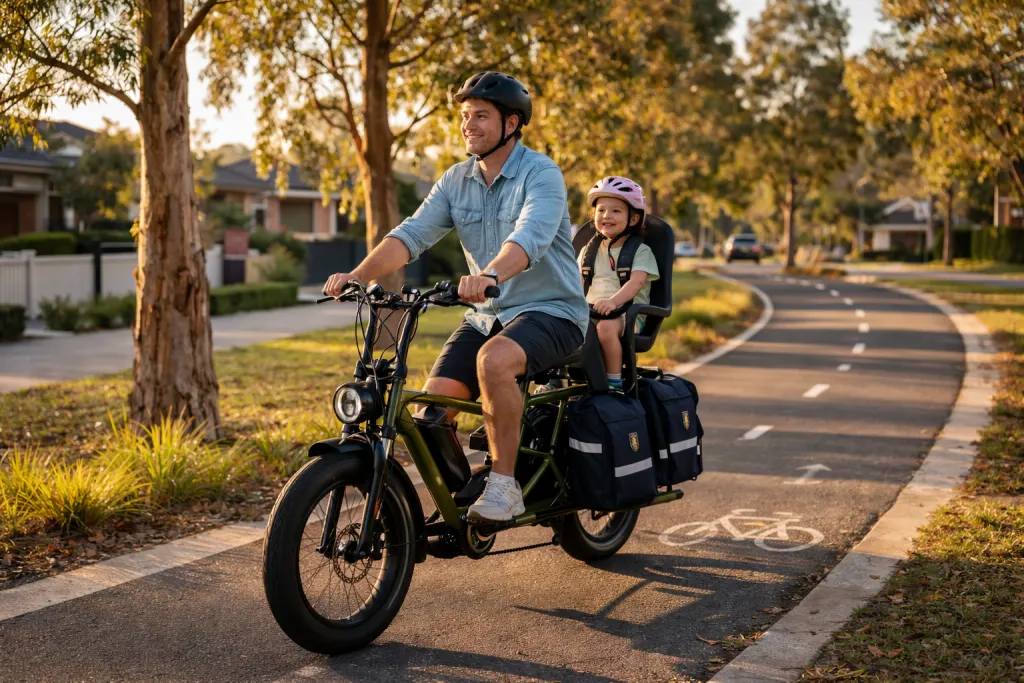
A cargo e-bike can genuinely replace a car for most short family trips. The school run, the grocery shop, weekend sport — if it’s within 10 km and doesn’t involve a motorway, a cargo bike will get you there faster and cheaper than driving.
Cargo Bike Types
There are two main styles, and each suits different families.
Longtail Cargo Bikes
The rear rack is extended to carry passengers or cargo behind the rider. These look closer to a regular bicycle, making them less intimidating for first-timers.
- Passenger capacity: Typically two children (with footpegs and a grab bar)
- Examples: Tern GSD, Benno Boost, Yuba Spicy Curry
- Pros: Narrower than front-loaders, easier to store, handles more like a normal bike
- Cons: Less cargo volume than a front-loader, kids sit behind you (harder to chat)
Front-Loader (Bakfiets) Cargo Bikes
A large box or bucket sits between the handlebars and the front wheel. Children sit in the box, facing you.
- Passenger capacity: Two to three children in the box, plus cargo
- Examples: Lug+Carrie, Urban Arrow, Babboe
- Pros: Huge carrying capacity, kids are visible in front of you, weather canopies available
- Cons: Longer wheelbase, harder to store, takes more practice to ride confidently
What Actually Fits
Families are often surprised by how much a cargo bike can carry. Here’s a realistic sense of capacity:
- School run: Two kids + two school bags + a musical instrument case
- Grocery trip: Four to six shopping bags (80–100 litres of cargo space on a front-loader)
- Sport: A child + cricket bag, or two kids + swimming bags
- Weekend errands: A flat-pack bookshelf from Bunnings (seriously)
Most cargo e-bikes have a payload capacity of 150–200 kg, including the rider. That’s more than enough for almost any family errand.
The School Run
This is where cargo bikes earn their keep. The morning school drop-off by car is, for many families, the most stressful fifteen minutes of the day. A cargo bike changes the dynamic completely.
- Leave when you’re ready — no traffic queue to worry about
- Use bike paths and quiet streets that cars can’t access
- Park right at the school gate
- The ride home is your exercise for the day
For families with kids at different schools or childcare, a longtail bike with two passenger positions handles the multi-stop morning with ease.
Hills and Motor Types
Cargo bikes are heavy — typically 25–35 kg before you add children and cargo. On flat ground, that’s barely noticeable with electric assist. On hills, motor choice matters.
Mid-drive motors (Bosch, Shimano, Brose) are the gold standard for cargo bikes. They use the bike’s gears, delivering strong torque on steep climbs even with a full load. Most premium cargo e-bikes use mid-drive systems.
Hub motors are found on some budget cargo bikes. They work adequately on gentle terrain but can struggle on hills when fully loaded.
If you live anywhere with hills — and most Australian cities have them — prioritise a mid-drive motor.
Brands Popular in Australia
The Australian cargo bike market has grown significantly. Some well-regarded options:
- Lug+Carrie — Australian-designed front-loader, built for local conditions
- Tern GSD — Compact longtail that folds for storage, Bosch motor
- Benno Boost — Versatile longtail with excellent accessory system
- Urban Arrow — Dutch front-loader, popular worldwide, now available through AU dealers
- Yuba — Longtail specialist with models at various price points
Expect to spend $5,000–$10,000 for a quality family cargo e-bike. It’s a significant outlay, but compare it to a year’s running costs of a second car. For a broader look at pricing, our spending guide breaks down what you get at each price tier.
The Learning Curve
Cargo bikes handle differently from regular bicycles. Be honest with yourself about this — it takes a few rides to adjust.
Front-loaders steer differently because the box is connected to the front wheel. Low-speed manoeuvring and tight turns require practice. Most riders are comfortable within a week.
Longtails feel more familiar but the extended rear changes the balance, especially when loaded. Start with lighter loads and build up.
Tips for the first week:
- Practice in an empty car park before hitting the road
- Start without passengers, then add kids once you’re confident
- Take corners slowly until you know the bike’s turning circle
- Use mirrors — the bike is wider than you’re used to
Storage at Home
This is the practical challenge nobody mentions in the brochure. Cargo bikes are big, and most Australian garages are already full of stuff.
- Front-loaders are typically 2.5 m long and won’t fit through a standard doorway sideways
- Longtails are more manageable — the Tern GSD even folds vertically for apartment storage
- A dedicated spot in the garage, carport, or under a covered area works best
- Bike covers protect against dust and weather if you’re storing outside
Measure your space before buying. It sounds obvious, but plenty of families have been caught out.
Frequently Asked Questions
Are cargo bikes safe for carrying children?
Yes. Modern cargo e-bikes are specifically engineered for passenger use, with low centres of gravity, child-rated seating, seatbelts or harnesses, and stable geometry. They’re slower than cars and use bike paths where possible, reducing the risk profile significantly.
What age can children ride as passengers?
Children can ride in a cargo bike from around 9–12 months (with an appropriate child seat insert) through to about age 8–9 or when they outgrow the seating. Older children typically prefer their own bike.
Can I ride a cargo bike in the rain?
Absolutely. Many front-loader cargo bikes have optional rain canopies that keep children dry. The rider will need wet-weather gear, but the bike itself handles rain without issue. Disc brakes maintain stopping power in wet conditions.
Do I need a licence to ride a cargo bike?
No. Cargo e-bikes that comply with Australian regulations (pedal-assist only, 250W nominal motor, 25 km/h speed limit) are classified as bicycles. No licence, registration, or insurance is required.