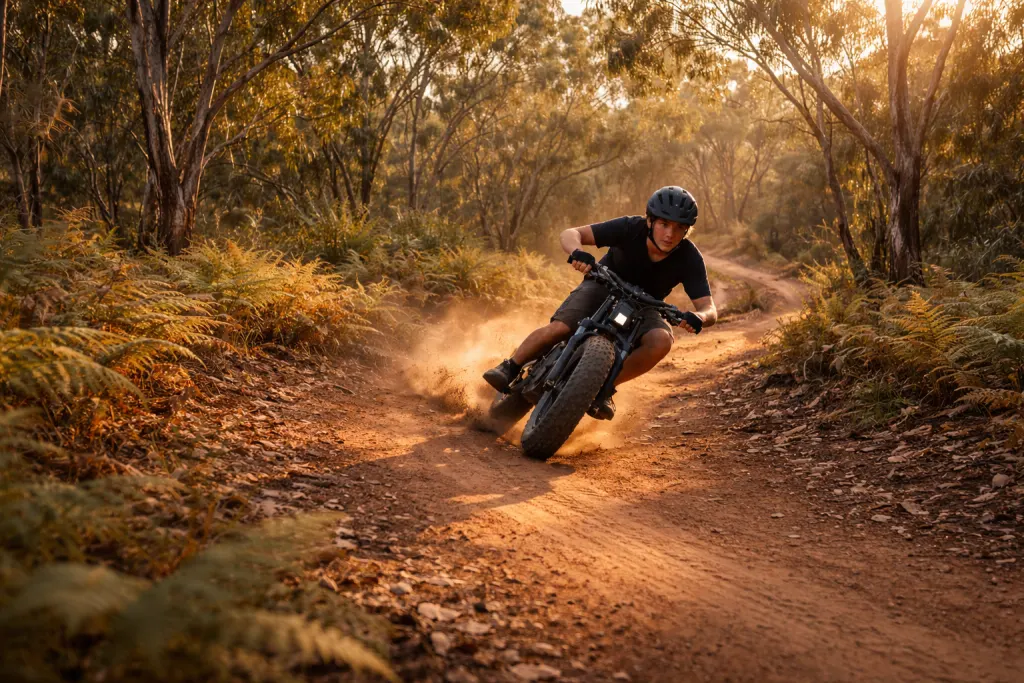
E-mountain bikes (eMTBs) have opened up trail riding to a much wider audience. For families and teenagers, they make off-road riding accessible even if fitness or experience would otherwise be a barrier.
Why eMTBs Appeal to Families
Trail riding is inherently more exciting than road cycling for most teenagers. Dirt, descents, rocks, roots — it’s physical and engaging in a way that appeals to younger riders. But traditional mountain biking demands serious fitness, especially on climbs.
An eMTB changes the equation:
- Climbs become manageable. The motor helps on the way up, so riders save energy for the fun descents.
- Range extends dramatically. A family ride that might cover 15 km on a regular mountain bike can stretch to 30–40 km on an eMTB.
- Fitness gaps disappear. A parent who hasn’t mountain biked in years can keep pace with a teenager who rides weekly.
Trail Access Rules in Australia
This is the most important thing to check before riding. Trail access for e-bikes varies by state, park, and even individual trail.
General principles:
- E-bikes that comply with Australian standards (pedal-assist only, 250W nominal, 25 km/h limit) are treated as bicycles in most jurisdictions
- National parks — rules vary by state. Some allow e-bikes on trails open to regular bikes; others restrict them. Check with the relevant parks authority before riding.
- State forests — generally more permissive, but still check local signage
- Purpose-built mountain bike parks — most welcome eMTBs on all trails, though some flow trails may have restrictions
- Private trail networks — check with the operator
State-by-state:
- VIC: E-bikes generally permitted where regular bikes are allowed in state forests and parks. Check Parks Victoria for specific trail status.
- NSW: National Parks NSW permits compliant e-bikes on management trails and many designated cycling tracks.
- QLD: Generally permitted on trails open to regular bikes. Some restrictions in specific conservation areas.
- SA, WA, TAS, NT, ACT: Rules vary — always verify with the local land manager before riding.
Trail access is evolving. Rules that applied last year may have changed. Always check before you ride.
Safety for Young Trail Riders
Off-road riding carries more risk than path riding, and younger riders need appropriate preparation.
Essential gear:
- A proper mountain bike helmet (full-face for technical trails)
- Gloves — gravel rash on palms is the most common injury
- Knee pads for rougher terrain
- Sturdy closed-toe shoes
- Plenty of water and sunscreen
Skills to build first:
- Braking control — using both brakes, especially on descents
- Body position — standing on the pedals for rough sections
- Line choice — reading the trail ahead
- Speed management — the bike can go faster than their skills might allow
Consider a mountain bike skills clinic. Many trail centres run sessions for young riders, and the investment in proper technique pays off in safety and confidence.
Choosing an eMTB for a Teenager
Teenagers need a bike that fits now, handles well, and won’t break the bank when they outgrow it in two years.
Key considerations:
- Frame size — proper fit is critical for control. Don’t buy too large with the idea they’ll “grow into it.”
- Suspension — a hardtail (front suspension only) is simpler, lighter, and cheaper. Full suspension suits rougher terrain but adds weight and cost.
- Wheel size — 27.5” wheels suit smaller riders and provide a more playful ride. 29” wheels roll better over obstacles but can feel unwieldy for shorter teenagers.
- Motor and battery — a mid-drive motor is strongly preferred for trail riding, and a smaller battery is fine for trail rides of 20–30 km. Bigger batteries add weight, which matters off-road.
Budget eMTBs start around $2,500, with mid-range models from $4,000–$6,000. For a teenager who’s still growing, the budget end is perfectly adequate. Our spending guide covers the full price range and what you get at each level.
Frequently Asked Questions
Can my teenager ride an eMTB on any trail?
Not necessarily. Trail access depends on the land manager’s rules, which vary by state and location. Always check before riding. Trails open to regular mountain bikes are generally — but not always — open to compliant e-bikes.
Are eMTBs harder to control than regular mountain bikes?
They’re heavier, which changes the handling, especially on steep descents and tight turns. The motor assist can also tempt riders to go faster than their skills support. Start on easier trails and progress gradually.
What’s the difference between a trail eMTB and an enduro eMTB?
Trail eMTBs have moderate suspension travel (120–140 mm) and suit a wide range of terrain. Enduro eMTBs have more suspension (150–170 mm) and are built for steeper, rougher trails. For most family riding, a trail eMTB is the better choice.