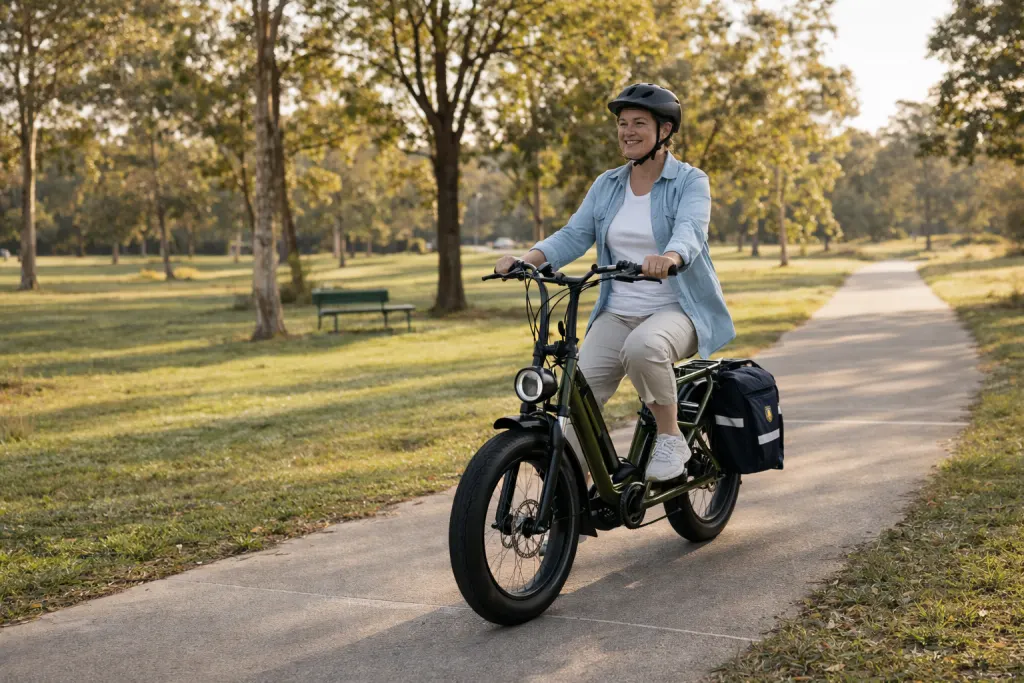
For older Australians, an e-bike can be genuinely life-changing. It restores a type of freedom that often fades with age — the ability to hop on a bike and go somewhere under your own power, without worrying about hills, distance, or arriving exhausted.
Why E-Bikes Suit Older Riders
The basic appeal is simple: an e-bike lets you ride a bicycle again, even if your fitness, strength, or joints aren’t what they used to be.
Pedal assist means:
- Hills that once stopped you are now manageable
- Headwinds don’t turn a pleasant ride into a slog
- You choose the effort level — ride gently or push harder, depending on how you feel
- You ride further and more often because every ride is enjoyable
Many seniors who haven’t ridden in years find that an e-bike brings cycling back into their lives. It’s not about going fast — it’s about going out.
Choosing the Right Bike
Not all e-bikes suit older riders. Here’s what to prioritise.
Step-Through Frames
A step-through (or low-step) frame is the single most important feature for senior riders. There’s no top tube to swing your leg over — you simply step through the frame and sit down. This makes mounting and dismounting far safer, especially if balance or flexibility is limited.
Comfortable Geometry
Look for an upright riding position with:
- Wide, cushioned saddle
- Swept-back handlebars that keep your wrists and shoulders relaxed
- Adjustable stem so you can fine-tune the handlebar height
Avoid sporty or aggressive riding positions. Comfort is everything for regular use.
Appropriate Weight
E-bikes are heavier than regular bicycles — typically 20–28 kg. For seniors, a lighter bike is easier to handle, especially when manoeuvring at low speed or pushing it up a driveway. Some brands specialise in lighter e-bikes, though they tend to cost more.
Good Brakes
Hydraulic disc brakes are the standard on most e-bikes and provide strong, consistent stopping power with minimal hand effort. This matters for riders whose grip strength may have reduced. Our e-bike types guide covers the full range of bike styles, including step-through commuter models that suit older riders well.
Speed Management
E-bikes in Australia are limited to 25 km/h pedal assist, which is a comfortable cruising speed for most riders. But speed isn’t the goal for senior riders — comfort and control are.
Practical tips:
- Start on the lowest assist level and work up gradually
- Use higher assist levels for hills, lower for flat paths
- Practise braking at different speeds in a safe area before riding in traffic
- Remember that the bike is heavier than a regular bicycle and takes longer to stop
Balance and Stability
Balance naturally changes with age, and this is a legitimate concern. A few features can help:
- Wide tyres (40 mm or more) provide a more stable contact patch
- Lower centre of gravity — some e-bikes position the battery low in the frame
- Three-wheel e-trikes are an option for riders who find two-wheel balance challenging
If you haven’t ridden in a while, start in a quiet park or empty car park. Your body remembers how to ride — it might just take a few minutes to come back.
Grandparents Doing School Pickups
This is a growing trend, and it makes perfect sense. Grandparents who live near the school can ride an e-bike for pickup, avoiding the car park chaos entirely.
- Arrive relaxed, without the stress of finding a park
- The grandkids love it — arriving by bike is much more fun than by car
- On a cargo bike or with a child seat, younger grandchildren can ride as passengers
- It’s a daily outing that combines exercise, fresh air, and family time
For grandparents who are the regular school-run backup, an e-bike can transform what was a stressful favour into an enjoyable routine.
Starting Slowly
There’s no rush. The best approach for a new senior rider:
- Test ride before buying. Most bike shops offer test rides. Try several bikes and find one that feels comfortable and stable.
- Start on quiet paths. Shared paths and quiet residential streets are ideal for building confidence.
- Keep rides short at first. Twenty minutes is plenty. Increase gradually.
- Ride regularly. Three short rides a week builds fitness and confidence faster than one long ride.
- Tell someone your route. Especially in the early days, let a family member know where you’re riding.
Safety Essentials
- Helmet — legally required in all Australian states
- Lights — front and rear, even for daytime riding
- Bright clothing — a hi-vis vest is cheap and effective
- Mobile phone — carry it charged, in a zip pocket or handlebar mount
- Regular bike checks — tyre pressure, brakes, lights, battery charge
Frequently Asked Questions
Is it too late to start cycling at 65 or 70?
Not at all. E-bikes are specifically suited to older riders because the assist compensates for reduced fitness or joint issues. Many riders in their 70s and 80s ride e-bikes regularly. Start gently, choose the right bike, and build up gradually.
What if I haven’t ridden in 20 years?
The saying is true — you don’t forget how to ride a bike. Balance returns quickly, usually within a few minutes. An e-bike is actually easier to balance than a regular bike at low speeds because the motor provides a smooth, steady push. Practice in a safe, open area first.
Are e-trikes a good option?
Three-wheeled e-trikes eliminate the balance concern entirely and are a solid choice for riders with stability issues. They’re wider than a standard bike, so they need more path space and won’t fit in some bike lanes. But for local errands and quiet paths, they work very well.
Should I tell my doctor before starting?
It’s sensible, especially if you have heart conditions, joint replacements, or balance issues. Most GPs are enthusiastic about cycling for older patients because it’s low-impact and excellent for cardiovascular health.