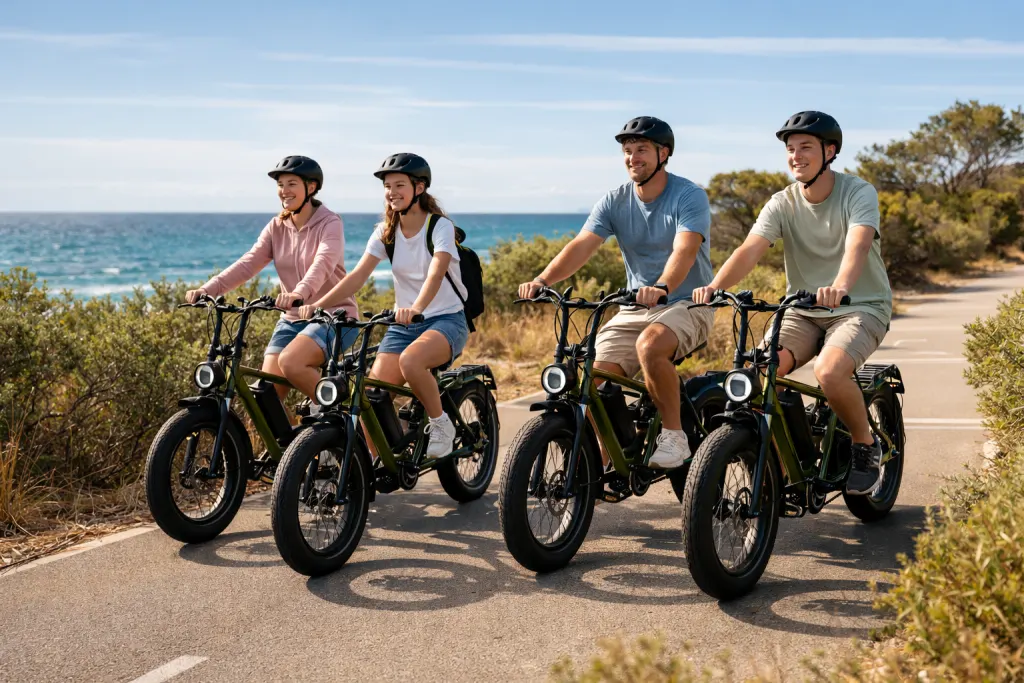
There’s a persistent myth that e-bikes are cheating. That the motor does all the work and riders get no exercise. The research says otherwise — and for families trying to get teenagers off screens and into the outdoors, an e-bike might be the most effective tool available.
The “Cheating” Myth
Let’s address this directly. A 2019 study published in Transportation Research Interdisciplinary Perspectives found that e-bike riders get roughly 95% of the cardiovascular benefit of conventional cycling. A larger review by Brigham Young University confirmed that e-bike riding qualifies as moderate-to-vigorous physical activity.
Why? Because the motor assists your pedalling — it doesn’t replace it. You still push the pedals. You still engage your legs, core, and cardiovascular system. The difference is that hills don’t defeat you, headwinds don’t exhaust you, and you ride further and more often as a result.
For teenagers especially, the assist removes the barriers that make regular cycling feel like a chore. It turns a ride into something they actually want to do.
Family Rides That Actually Work
Every family with mixed fitness levels knows the problem: the fittest rider charges ahead, the slowest rider falls behind, and everyone ends up frustrated.
E-bikes solve this elegantly. A parent recovering from an injury can ride alongside a sporty teenager. A younger sibling can keep up with older kids. A grandparent can join a family ride they’d otherwise skip.
How it works in practice:
- Less fit riders use higher assist levels
- Fitter riders dial the assist down or switch it off
- Everyone rides at the same pace, together
- The ride is enjoyable for all, not a test of endurance
This makes weekend rides a genuine family activity rather than a logistical compromise.
Getting Teenagers Outside
Screen time is a concern for most Australian parents. The challenge isn’t convincing teenagers that outdoor activity is good for them — they know. The challenge is offering something that competes with the appeal of devices.
E-bikes have a few things going for them:
- They’re cool. Modern e-bikes look good, and teenagers care about that.
- They offer freedom. Riding to a mate’s house, to the shops, to the beach — without needing a lift.
- They’re social. Group rides are a natural teenage activity, and e-bikes make them accessible to everyone, not just the sporty kids.
- They involve a gadget. The display, the assist levels, the range tracking — there’s a tech element that appeals.
The families who have the most success aren’t forcing their teenagers to ride. They’re providing the bike and letting the independence do the rest.
Trail Riding and Exploration
Beyond commuting and errands, e-bikes open up recreational riding that might otherwise feel too ambitious.
- Rail trails — flat, scenic, and often 20–50 km long. Perfect for a day out with the family. Our touring guide lists the best family-friendly rail trails around Australia.
- Local bushland tracks — many councils maintain shared-use paths through parks and reserves.
- Coastal paths — the stretch from Manly to Palm Beach, the Bay Trail in Melbourne, the coastal path in Perth — all brilliant on an e-bike.
For teenagers, exploration is the key motivator. The e-bike’s range means they can ride further than a pushbike allows, discover new places, and build genuine confidence on two wheels.
Mental Health Benefits
This deserves its own section because it matters.
Teenage mental health in Australia is under significant pressure. Beyond Blue reports that one in four young Australians experiences a mental health condition in any given year. Physical activity is consistently identified as one of the most effective protective factors.
Regular cycling — even with assist — delivers:
- Reduced anxiety and stress
- Improved sleep quality
- A sense of achievement and capability
- Social connection through group rides
- Time outdoors in natural light
An e-bike lowers the barrier to all of these benefits. A teenager who wouldn’t ride a pushbike up a hill will happily ride an e-bike. The result is more rides, more often, and better wellbeing.
Frequently Asked Questions
Do e-bike riders actually get fit?
Yes. Multiple peer-reviewed studies confirm that e-bike riding provides moderate-to-vigorous physical activity. Riders still pedal, engage major muscle groups, and elevate their heart rate. The main difference is that e-bike riders tend to ride more frequently and for longer distances than conventional cyclists.
What’s the best type of e-bike for recreational riding?
A hybrid or commuter e-bike suits most recreational riding — comfortable upright position, wide enough tyres for mixed surfaces, and good range. For trail riding, consider an e-mountain bike with suspension. For teenagers, ensure the frame size is appropriate for their height.
Will my teenager outgrow the bike quickly?
Teenagers grow, and that’s worth planning for. Many e-bikes come in size ranges that accommodate growth. Some families start with a slightly larger frame and adjust the seat height as their child grows. Budget models can be a smart choice for this reason — plan to upgrade in two to three years.
Is riding with headphones safe?
No. Riding with headphones — even one earbud — significantly reduces awareness of traffic, other riders, and hazards. It’s also illegal in some Australian states. Encourage your teenager to ride without them.